Sunday, May 17, 2015

4/1/15

Absolute Advantage v. Comparative Advantage

•Absolute Advantage

-Individual: exists when a person can produce more of a certain good/service than someone else in the same amount of time.
-National: exists when a country can produce more of a good/service than another country can in the same time period.

•Comparative Advantage

-Individual/National: Exists when an individual or nation can produce a good/service at a lower opportunity cost than can another individual or nation.
•Absolute Advantage
   -Faster, more, more efficient
•Comparative Advantage
    -lower opportunity cost

Foreign Exchange Market

Foreign exchange market (3/15)

•The buying and selling of currency. 
•the exchange rate is determined in the foreign currency markets. 
•it is the price of a currency. 


Tips
•always change the demand line on one currency graph, The S line on the other currency's graph
•move the lines of the two currency graphs in the same direction (right or left) and you will have the correct answer
•if D on one graph increases, S on the other will also increase 
•if D moves to the left, S will move to the left on the other graph. 

Changes in exchange rates 

•exchange rates are a function of the supply and demand for currency. 
-an unease in the supply of a currency will make it cheaper to buy one unit of that currency. 
-a decrease in supply of a currency will make it more expensive to buy one unit of that currency. 

•an increase in demand for a currency will make it more expensive to buy unit of that currency 
•a decrease in demand for a currency will make it cheaper to buy one unit of that currency 

Appreciation 

•it occurs when the exchange rate of hat currency increases 

Exchange rate determinants 

consumer tastes 
•relative income 
-imports tend to be normal goods 
•relative price level 
•speculation 

Depreciation 

•occurs when the exchange rate of that currency decreases. 

Official Reserves

Official reserves (3/13)

•the foreign currency holdings of the U.S. federal reserve system
•when there is a balance of payments surplus the Fed accumulates foreign currency and debits the balance of payments. 
•when there is a balance of payments deficit the Fed depletes its reserves of foreign currency and credits the balance of payments. 
•the official reserves zero out the balance of payments. 


•Active official reserves Vs. Passive 
- the U.S. is passive in its use of official reserves. It does not seek to manipulate the dollar exchange rate. 
- the people's republic of china is active in its use of official reserves. It actively buys and sells dollars in order to maintain a steady exchange with U.S. 

Sunday, April 12, 2015

Philips Curve - April 9, 2015

Philips Curve

•Represent relationship between unemployment and inflation.
•Trade off between inflation and unemployment only occurs in the short run. 

1) Short-Run Philips Curve (SRPC)

•There is an inverse relationship between inflation and unemployment. 
•it has a relevance to Okun's law.
•since wages are sticky, inflation changes move the points on the SRPC 
•if inflation persists, and the expected rate of inflation rises, then the entire SRPC moves upward which causes stagflation. 
•if inflation expectations drop due to new technology or economic growth, then the SPRC will move downward. 
•AS shocks can cause both higher rates of inflation and higher rates of unemployment. 

•Supply shocks rapid and significant increases in resource cost.


Misery Index

A combination of unemployment and inflation in any given year.
Single digit misery is good. 

2) Long-Run Philips Curve (LRPC)

Natural rate of unemployment 
-4-5% (full employment)
If the natural rate of employment changes, the vertical line changes
•it is represented by a vertical line.
•there is no trade off between unemployment and inflationary in the long run
•the economy runs at a full employment level. 
• LRPC will only shift if the LRAS curve shifts otherwise it is assumed to be stable. 


A) NRU= seasonal, frictional, structural 

Major LRPC assumption

More worker benefits create higher natural rates and fewer worker benefits create lower natural rates. 

SRAS - April 1, 2015

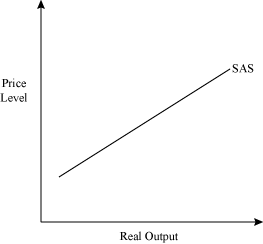
Short run AS


  • Time too short for wages to adjust to the price level
  • Workers may not be aware of changes in their real wages due to inflation and have adjusted their labor supply decisions in wage demands accordingly. 


Nominal wages


  • The amount of money received per day, per hour or per year.

Real wage 

  • Wages not estimated in money but purchasing power.

Sticky wages


  • Nominal wage level is set according to an initial price level and it does not vary. 

Monday, March 30, 2015

The loanable funds market (3/23)


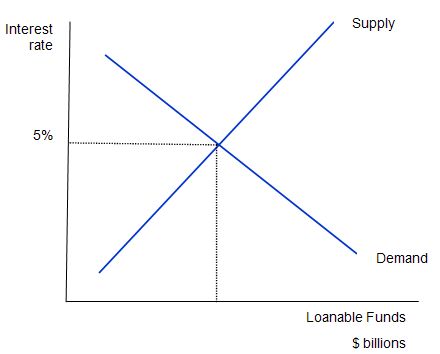
•The market where savers and borrowers exchange funds (QLF) at the real rate of interest (r%)
•The demand for loanable funds, or borrowing comes from households, firms, government and the foreign factor. The demand for loanable funds is in fact the supply of bonds. 
•The supply of loanable funds, or saving comes from households, firms, government and the foreign sector. The supply of loanable funds is also the demand for bonds. 

Change in demand for loanable fun
ds


•demand for loanable funds = borrowing (ie supplying bonds) 
•more borrowing = more demand for loanable funds (->)
•less borrowing = less demand for loanable funds (<-) 

Examples
•government deficit spending = more borrowing = more demand for loanable funds 
•less investment demand = less borrowing = less demand for loanable funds 

Changes in supply of loanable funds 

• supply of loanable funds = Saving (ie demand for bonds) 
• more saving = more supply of loanable funds (->) 
•less saving = less supply of loanable funds (<-) 

Examples 
• government budget surplus = more saving = more supply of loanable funds 
• decrease in consumers' MPS = less saving = less supply of loanable funds 

•When government does fiscal policy, it will affect the loanable funds market 
•changes in the real interest rate (r%) will affect gross private investment.